Saturday, March 29, 2014

God and the Four Causes: Are Things Preserved in Their Being by God? (Part I) 6/09/13


Four Causes

In the first article of the fifth question of St. Thomas Aquinas' De Potentia (On The Power of God), Aquinas asks the following question: "Are Things Preserved in Their Being by God?" He points out the key aspects of the issue: "The question at issue is about the preservation of things in their being by God: and the first point of inquiry is whether they continue to exist independently of all divine action: and seemingly they do." Aquinas wants to argue for God's creative acts of existence, claiming that the world would fall into nothingness if God were to withhold his preservative power: "On the contrary it is written (Heb. i, 8): Upholding all things by, the word of his power: and the gloss remarks 'Even as all things were created by him, so by him are they preserved unchangeable.'"

In order to fully understand and appreciate Aquinas' approach to this question, we need to learn more about his Aristotelian terminology (i.e. Aristotle's Four Causes: the material cause, the efficient cause, the formal cause, and the final cause). Aristotle believes that we need a sufficient grasp of a thing's underlying causes or principles in order for us to claim to have knowledge about a particular thing or a phenomenon in the world (Stanford Encyclopedia of Philosophy). These four causes, according to Aristotle, exhaust the possible answers to the "why-question" of a thing. The following x paragraphs will attempt to properly define the Four Causes and provide numerous examples to supplement our understanding of them.

Firstly, the material cause is the "that out of which" or "that from which" of a thing. The material cause points to the material components or parts of a thing. Take for instance Aristotle's example of the statue. What would be the material cause of the statue? Depending on what the statue is made of, one might say copper, marble, or iron. The material make-up of the statue would take the place of the material cause of the question, "Why is this a statue?", because bronze would answer to the substratum that the form actualizes. Moreover, the flesh and bones of a human being would also be material causes explaining why this thing is a human being and not anything other than a human being.

Secondly, the efficient cause answers to the "primary source of the change or rest" or "that by which" of a thing. It points to the cause of its becoming what it is, the cause being that by which the thing came to be (in philosophical jargon: the bodily agent whereby the form or the characterization of the bronze as statue becomes induced in the now properly disposed matter, the bronze then unshaped now shaped so as to contain the form of the statue). Take for instance Aristotle's example of the statue again. The sculptor would be the efficient cause of the statue because the sculptor transmutes the matter of the statue, the bronze, in such a way that would allow the form to actualize the bronze into a statue.

To be continued...

The Ark of the Covenant and the Virgin Mary, Holy Queen and Holy Mother 5/23/13 7/16/14

Jeremiah Hiding the Ark of the Covenant
In his book, Hail, Holy Queen, Dr. Scott Hahn referenced Sacred Scripture in order to establish Mary as the "New Eve," the long-lost ark of the covenant, and someone to be exalted on high. He used the following holy books to argue for her majesty and employed many others: Genesis, 2nd Samuel, Jeremiah, Daniel, Luke, John, and Revelation.

In his book, Hahn noted Jeremiah's solitary role in "conceal[ing] the ark in order to prevent it from defilement when Babylonian invaders came to destroy the temple [of Jerusalem]" (Hahn 51). Scholars have dated this event at around 587 B.C.; the ark had been missing ever since the invasion (Hahn 51). Hahn also quoted Sacred Scripture, the deutero-canonical/apocryphal text, and referred to the ark's concealment*:
And Jeremiah came and found a cave, and he brought there the tent and the ark and the altar of incense, and he sealed up the entrance. Some of those who followed him came up to mark the way, but could not find it. When Jeremiah learned of it, he rebuked them and declared: “The place shall be unknown until God gathers his people together again and shows his mercy. And then the Lord will disclose these things, and the glory of the Lord and the cloud will appear, as they were shown in the case of Moses, and as Solomon asked that the place should be specially consecrated.” (2 Maccabees 2:5-8)
Although the ark had indeed been lost during the Babylonian Exile, St. Luke wrote that the ark was finally found in the Virgin Mary. Luke used some passages from 2nd Samuel in order compare its striking parallels with the Virgin's life: Mary traveled to the house of Zechariah in the hill country of Judea, as King David had done with the ark of covenant (Luke 1:39, 2 Samuel 6:2-3). Both figures traveled over the Judaean highlands in order to reach their destination. Both stories began with the two having "[arisen] and went" (Luke 1:39, 2 Samuel 6:2), which associated the two figures with each other -- or three rather. Moreover, Elizabeth's question to Mary paralleled King David's question to the Lord after He struck Uzzah on the spot (Luke 1:43, 2 Samuel 6:9). The unborn John the Baptist's leap to Mary's greeting also resembled King David's dance before the ark of the covenant, following his triumphant entrance into Jerusalem (Luke 1:41, 1:44; 2 Samuel 6:5, 6:14-17). Interestingly, Zechariah, Elizabeth's spouse, had been attending to his priestly duties at the temple of Jerusalem during this time, about twenty-five miles north of Hebron, his hometown. The angel Gabriel had told him that his son would be Christ's forerunner before he dumbstruck Zechariah for his momentary doubt (Luke 1:18-22). In other words, there appeared to be some connection between Zechariah's priestly duties at Jerusalem and King David's entrance into the same city. Either way, both sets of figures had been present in the hill country of Judea when these events happened. Finally, Hahn closed his account of the two stories by reinforcing their connection: "…the ark remained in the hill country for three months (2 Samuel 6:11), the same amount of time Mary spent with Elizabeth ([Luke] 1:56)" (Hahn 64).

King David and the Ark of the Covenant

All these related gestures from the Old Testament to the New established Mary as the 'ark of the covenant', since both had borne the Word of God, but in different ways. The ark bore the Word of God in stone tablets, manna "the Bread of Life," and the iron rod of Aaron; the Virgin Mary carried the Lord, the Word of God en-fleshed.

St. John also demonstrated this same parallel in his book entitled Revelation, which he wrote after the Virgin's death. After the seventh angel had blown his trumpet, the ark of the covenant appeared in all of its splendor and glory: "Then God's temple in heaven was opened, and the ark of his covenant was seen within his temple; and there were flashes of lightning, loud noises, peals of thunder, an earthquake, and heavy hail" (Revelation 11:19). As mentioned earlier, Jews around the time of the Babylonian Exile lost the ark of the covenant, which was then God's presence in the temple of Jerusalem. Great sadness ensued when this prized possession was lost. Yet, John wrote this in order to capture the attention of his audience for Revelation 12:

A great portent appeared in heaven, a woman clothed with the sun, with the moon under her feet, and on her head a crown of twelve stars; she was with child and she cried out in her pangs of birth, in anguish for delivery. And another portent appeared in the sky; behold, a great red dragon, with seven heads and ten horns, and seven diadems upon his heads . . . And the dragon stood before the woman who was about to bear a child, that he might devour her child when she brought it forth; she brought forth a male child, one who is to rule all the nations with a rod of iron . . . . (Revelation 12:1-5)

The Great Red Dragon and the Woman Clothed in Sun (1805-1810) by William Blake
Daniel 7 held the key for unlocking the dragon's unknown name. In Daniel; dragons, creatures, and beasts represented dynasties. The beast in Revelation was King Herod's dynasty because the rise of the Davidic and messianic king threatened his claim to power. Herod killed most of the infants of Bethlehem in order to circumvent any threats to his illegitimate reign (Matthew 2). Moreover, "seven Herod's" ruled in line from Antipeter, and the "ten Caesar's" from Rome's imperial line corresponded to the dragon's seven heads and ten horns in Revelation (Hahn 58). In other words, John wrote a historical narrative and employed dramatic metaphors and characters in order to link Rome's fall with Christ's victorious reign. John described the Virgin and Christ Jesus as the dragon's wartime enemies: "Then the dragon was angry with the woman, and went off to make war on the rest of her offspring, on those who keep the commandments of God and bear testimony to Jesus" (Revelation 12:17). All who had new life in Christ became offspring of Mary, and all who had considered themselves to be followers in Christ also needed to believe that they were the children of Mary, as brethren in Christ and Mary as their mother.

Finally, Jesus referred to the Virgin as "woman" (John 2:4, 20:13, 20:15, 19:26), which hearkened back to Eve's name in the Genesis, "'This at last is bone of my bones and flesh of my flesh; she shall be called Woman, because she was taken out of Man'" (Genesis 2:23). Even while the Romans crucified Him, Jesus repeated the New Eve's name and prophetic fulfillment from Genesis: "When Jesus saw his mother, and the disciple whom he loved standing near, he said to his mother, 'Woman, behold, your son!' Then he said to the disciple, 'Behold, your mother!' And from that hour the disciple took her to his own home (John 19:26-27). Mary fulfilled Eve's title as "mother of all living" (Genesis 3:20) and fought the dragon in Revelation, the "ancient serpent" and "deceiver of the whole world" (Revelation 12:9, Genesis 3:13).

Although the Virgin was not divine like her Son, she is our exemplary intercessor par excellence and our Heavenly Mother of the Most High. Amen.

Virgin Mary and Jesus

*The block quote was taken from another Bible translation: Revised Standard Version, Catholic Edition.

William Buckley and Mortimer Adler on the Human Intellect 5/08/13


Something I would like to add here. Take someone who understands, not sees or imagines but understands, a common object rather than a particular object (e.g. apple rather than this red apple). The person incidentally changes form from not-understanding apple to understanding apple, which is a change that is substantially different from say this apple changing from not-red to red. The apple changing from not-red to red appears to us a new and different change occurring in matter, but the person changing from not-understanding apple to understanding apple, and also in a certain way the apple changing form from not being understood to being understood, does not appear to us in sensible fashion, which thereby suggests the immaterial nature of the human person's intellective capacity, the human intellect (nous).

Adler's comment on the low degree of spirituality in human beings fascinates: "Man has both his feet in the world of matter and is leaning over the fence --- as it were --- with his intellect into the world of spirit." Adler stays close to the Thomistic tradition in comparing the angels, the highest intellectual substances separated from matter, to human beings, the lowest intellectual substances in matter.

From the Finite to the Infinite: A Pagan's Journey to the Promised Land (Revised) 5/07/13 03/12/14


School of Athens
All of us desire to know where we are going with our lives. What does it all mean? What can we hope for? The humanities or the liberal arts might answer these questions, but there are many issues to consider. What is an eager truth-seeker to do? Indeed, analyzing the truth will be much easier to pursue if we consider their principles.

In previous articles, we explored modern philosophy from this bird's eye view. Let us now explore Ancient Greek philosophy and Medieval Scholasticism and ask the same questions they would have asked if they were here. Is there a God? What can we hope for? These obscure philosophers asked the most profound questions, and we still struggle to answer them. Let us now attempt to prove for His existence in the same way in which they had done so.

If we are going to prove for God's self-existence and independent existence from the cosmos, we need to begin with an elaboration of the various objects of the cosmos. Only then can we demonstrate for a being in reality that corresponds to the notion of a self-existing and independently existing God.

Cosmos
Thirteenth century Dominican friar, St. Thomas Aquinas, began with what he thought was obvious: diversum est esse et id quod est—that what a thing is and its existence are not the same. There are many things that exist, but distinguishing between various things requires that we define them as being other than their existence.

We also understand what things are regardless of their existence (e.g. unicorns, vampires, etc.). Therefore, every contingent being's essence (i.e. those by which we understand the things of the cosmos according to their kind) is not the existence they have. Since a contingent being's essence does not guarantee its existence, we must appeal to an extrinsic cause for its existence.

Since contingent beings do not exist necessarily, we must appeal to external beings to account for their existence, but appealing to contingent beings to account for other contingent beings will cause an infinite regress. Therefore, contingent beings will not suffice to account for their existence.

Aquinas thus concluded that the cosmos exists but does not exist though itself, and everything open to our common experience exists contingently. An appeal to the cosmos, however, will not suffice to explain the cosmos' contingency.

Finally, there must exist some transcendent Being who is the ultimate cause of the cosmos' nexus of conditioned causality. In other words, there must exist a transcendent Being whose essence is His own existence and thereby exists through the power of His own essence.He must exist this way. Otherwise, He will not have His own reason for existing and would cease to exist necessarily.

There must also be no possibility in this transcendent Being for being something other than what He is. This Being, in other words; must be purely actual, indeterminate, or unrestricted being and existence. We shall henceforth call this subsistent existence God.

What name could we give for God that best expresses who He is? We must name God using an extraordinary mode of predication that is distinct from the modes of predication used for contingent beings. Since Being is God's proper name; the infinitive of the verb, being (viz. 'to be') best expresses His indeterminate existence. The propositions "God is the One who is 'to be,'" 'God is He that is,' and 'God is' best communicate His name.

Aquinas also quoted from a passage in St. John of Damascus' Exposition of the Orthodox Faith, which reads that God's name denominates an "infinite ocean of substance." In other words, God is the sheer act of 'to be' itself, the least imperfect name for God.

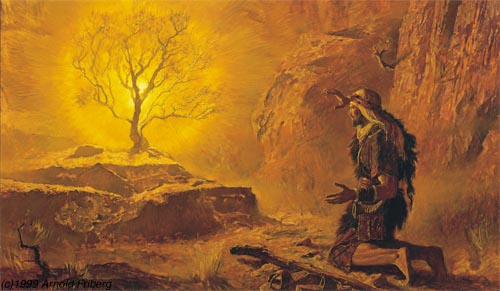
The Christian, Jewish, and Muslim Old Testament traditions speak to the Lord's name as well but from the standpoint of divine revelation. Surprisingly, they all claim that God revealed His name to Moses:

Then Moses said to God, "If I come to the people of Israel and say to them, 'The God of your fathers has sent me to you,' and they ask me, 'What is his name?' what shall I say to them?'" God said to Moses, "I AM WHO I AM." And he said, "Say this to the people of Israel, 'I AM has sent me to you,'"

God also said to Moses, "Say this to the people of Israel, 'The Lord, the God of your fathers, the God of Abraham, the God of Issac, and the God of Jacob, has sent me to you': this is my name for ever, and thus I am to be remembered throughout all generations." (Exodus 3:13-15)

The Douay-Rheims translation also expresses God's name as the Septuagint reads it: "God said to Moses: I AM WHO AM. He said: Thus shalt thou say to the children of Israel: HE WHO IS, hath sent me to you" (Exodus 3:14). I AM, HE WHO IS, YHWH (Hebrew: יהוה), or the Lord's name is the God of the Bible and the God of Israel. More specifically; the verb form, YHWH, derives from the triconsonantal root היה (h-y-h) 'to be.' Indeed, the Lord's name integrates rather well with God as Being itself.

Moses and the Burning Bush

The biblical authors also wrote the book of Exodus about ten centuries before the coming of Christ; writing how God, with Moses' help, freed the enslaved Israelites from the Egyptian rulers and established a covenant with God on Mount Sinai.

They also claimed that the narrative had taken place thirteen centuries before the coming of Christ. Interestingly, the biblical authors wrote the Pentateuch long before philosophy began in ancient Greece. Yet, the earliest and most archaic arguments for God's existence date at around 400-340 B.C., beginning mostly with Plato and Aristotle's arguments, and later with Aquinas' arguments into the High Middle Ages.

How did the ancient Israelites know God's name, thousands of years before the Greeks and the Medieval Scholastics knew it? The ancient Israelites constantly fought with one another with no time for theoretical study. With that said, however, they claimed to know God's name not in the way in which the Greeks had. They claimed that it was revealed to them by God.

God, moreover, established a series of covenants with different people over many centuries. They all ruined them by turning away from Him. Despite that fact, however, God reinstated new covenants in order to unite Himself with His people.

Moreover, later prophecies claimed that the Lord would  redeem Israel from her misdeeds and reign as King in an everlasting covenant with all nations. The Messiah, as they called Him, will descend from the Davidic bloodline in order to do so. In fact, the New Testament references these claims Gospels' genealogies, tracing Jesus Christ's ancestry from the Old Covenant:


The book of the genealogy of Jesus Christ, the son of David, the son of Abraham. Abraham was the father of Isaac, and Isaac the father of Jacob, and Jacob the father of Judah and his brothers, and Judah the father of Perez and Zerah by Tamar, and Perez the father of Hezron, and Hezron the father of Ram, and Ram the father of Ammin'adab, and Ammin'adab the father of Nahshon, and Nahshon the father of Salmon, and Salmon the father of Bo'az by Rahab, and Bo'az the father of Obed by Ruth, and Obed the father of Jesse, and Jesse the father of David the king…

and Jacob the father of Joseph the husband of Mary, of whom Jesus was born, who is called Christ. So all the generations from Abraham to David were fourteen generations, and from the deportation to Babylon to the Christ fourteen generations. (Matthew 1:1-17)


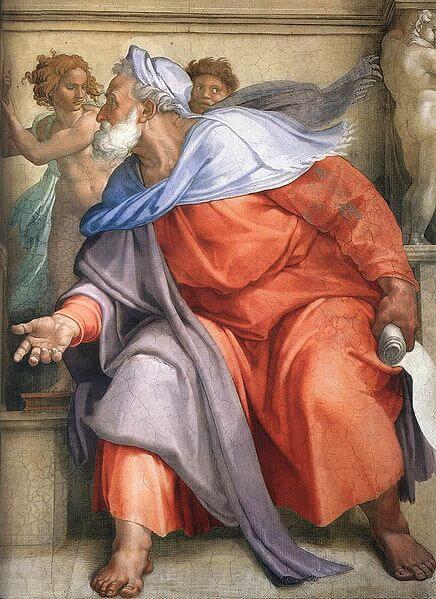
Ezekiel, the Prophet
Moreover, a priest and prophet, Ezekiel, envisioned God leaving the corrupt temple of Jerusalem and restoring order: "Then he led me to the gate, the gate facing toward the east; and behold, the glory of the God of Israel was coming from the way of the east... And the Spirit lifted me up and brought me into the inner court; and behold, the glory of the Lord filled the house" (Ezekiel 43:1-5). Ezekiel's prophetic vision prefigured Christ's triumphal entry from the Mount of Olives, just east of Jerusalem, to the temple.

Jesus Christ also fulfilled Ezekiel's prophesy by driving the corrupt out of his temple: "[Jesus Christ] entered the temple and began to drive out those who were selling, saying to them, 'It is written, 'and my house shall be a house of prayers,' but you have made it a robbers' den'" (Luke 19:45, 46).

On a further note, Jesus Christ's name, "'YHWH or He who is' saves, the Messiah," also testifies to God's self-revelation to Moses. In a particular passage in John's gospel, Jesus Christ urged his fellow Jews to have faith that He and His Father are one. When Jesus told them that Abraham was glad when he came to Him, the Jews asked Him, "You are not yet fifty years old, and have you seen Abraham?" (John 8:57). Jesus then replied by reaffirming His divinity: "'Truly, truly, I say to you, before Abraham was, I am'" (John 8:58).

Finally, Jesus also intimately expressed His love towards His present and future disciples at the Garden of Gethsemane, where he had prayed an act of petition before the Sanhedrin took him prisoner to be crucified for blasphemy:

When Jesus had said this, he raised his eyes to heaven and said, “Father, the hour has come. Give glory to your son, so that your son may glorify you, just as you gave him authority over all people, so that he may give eternal life to all you gave him. Now this is eternal life, that they should know you, the only true God, and the one whom you sent, Jesus Christ. I glorified you on earth by accomplishing the work that you gave me to do. Now glorify me, Father, with you, with the glory that I had with you before the world began.

Angel Consoling Jesus
I revealed your name to those whom you gave me out of the world. They belonged to you, and you gave them to me, and they have kept your word. Now they know that everything you gave me is from you, because the words you gave to me I have given to them, and they accepted them and truly understood that I came from you, and they have believed that you sent me.

I pray for them. I do not pray for the world but for the ones you have given me, because they are yours, and everything of mine is yours and everything of yours is mine, and I have been glorified in them. And now I will no longer be in the world, but they are in the world, while I am coming to you.

Holy Father, keep them in your name that you have given me, so that they may be one just as we are. When I was with them I protected them in your name that you gave me, and I guarded them, and none of them was lost except the son of destruction, in order that the scripture might be fulfilled. But now I am coming to you.

I speak this in the world so that they may share my joy completely. I gave them your word, and the world hated them, because they do not belong to the world any more than I belong to the world. I do not ask that you take them out of the world but that you keep them from the evil one. They do not belong to the world any more than I belong to the world. Consecrate them in the truth. Your word is truth. As you sent me into the world, so I sent them into the world. And I consecrate myself for them, so that they also may be consecrated in truth.

I pray not only for them, but also for those who will believe in me through their word, so that they may all be one, as you, Father, are in me and I in you, that they also may be in us, that the world may believe that you sent me.

And I have given them the glory you gave me, so that they may be one, as we are one, I in them and you in me, that they may be brought to perfection as one, that the world may know that you sent me, and that you loved them even as you loved me. Father, they are your gift to me. I wish that where I am they also may be with me, that they may see my glory that you gave me, because you loved me before the foundation of the world.

Righteous Father, the world also does not know you, but I know you, and they know that you sent me. I made known to them your name and I will make it known, that the love with which you loved me may be in them and I in them. (John 17)